
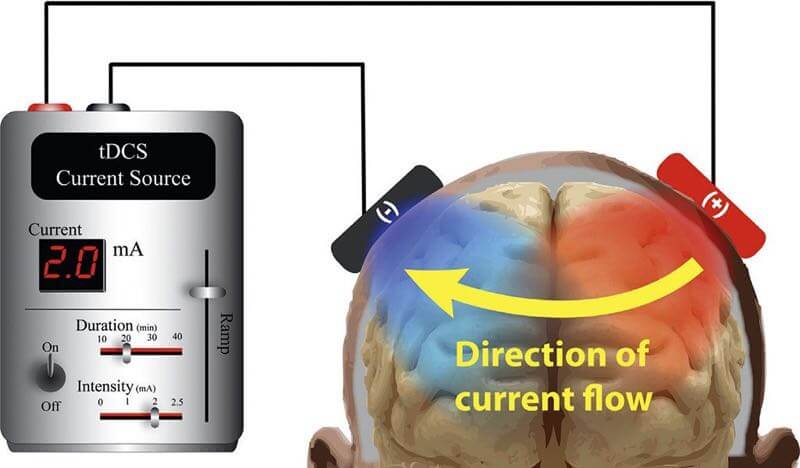
Transcranial direct current stimulation (tDCS) is a non-invasive and painless brain stimulation treatment that uses direct electrical currents to stimulate specific parts of the brain. A constant, low-intensity current passes through two electrodes placed above the head, modulating neuronal activity.
tdcs: transcranial direct current stimulation
tdcs or transcranial direct current stimulation
What is DCS or transcranial direct current stimulation ?
Transcranial direct current stimulation (tDCS) is a form of neurostimulation that uses a low-level electrical current. This current is used to specifically target different brain regions. Depending on the targeted brain region, tDCS can produce different results. The current used is a low-intensity direct current that does not trigger an action potential. Instead, tDCS works by bringing a neuron closer to triggering, also known as « priming, » by facilitating depolarization. The overall process is called « neuroplasticity, » which is the brain’s ability to reorganize and build/strengthen neural networks in response to activity.
Consumer tDCS products are not medical devices. In Europe, tDCS has received CE marking for depression and chronic pain such as migraines and fibromyalgia. tDCS research is ongoing for aphasia, motor recovery, addiction, cognitive enhancement, and other applications.
How does the TDCs work ?
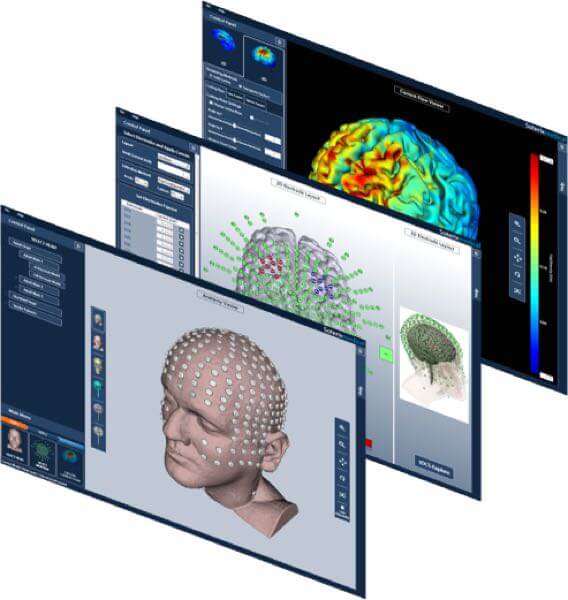
Transcranial direct current stimulation (tDCS) is a form of non-invasive neurostimulation that delivers a low-level, constant current to the brain using electrodes typically placed on the scalp. This neuromodulation technique uses a constant current of 1 to 2 mA delivered by electrodes to targeted brain regions to modulate brain function. By using different electrode configurations, tDCS can be used to excite or inhibit neuronal activity in the targeted area.
Unlike transcranial magnetic stimulation (TMS), the current used in tDCS is not strong enough to trigger an action potential but rather affects the resting membrane potential of neurons. When applying anodal (positive) stimulation, the electrode is used to facilitate the depolarization of neurons, resulting in excitatory stimulation. Conversely, during cathode (negative) stimulation, the electrode is used to induce hyperpolarization of neurons resulting in inhibitory stimulation.

Some studies on tdcs
-
- Targeting the cerebellum with non-invasive neurostimulation: a review
(The Cerebellum, 2017) - Cerebellar tDCS: Where do we stand in 2016? Technical questions and critical literature review.
Frontiers in Human NeuroScience, 2016
- Transcranial direct current cerebellar stimulation (ctDCS): a new approach to understanding cerebellar function in health and disease.
The Neuroscientist, 2014
- Transcranial direct current stimulation of the right dorsolateral prefrontal cortex improves error awareness in older adults.
The Journal of Neuroscience, 2014 - Evidence-based guidelines on the therapeutic use of transcranial direct current stimulation (tDCS)
Clinical Neurophysiology, 2017 - Non-pharmacological interventions for chronic pain in people with spinal cord injury.
Cochrane Database Syst Rev. 2014 - Improving attention, learning, and memory in healthy adults using transcranial direct current stimulation
(NeuroImage, 2014) - tDCS in post-stroke aphasia: the role of stimulation parameters, behavioral treatment, and patient characteristics.
Cortex, 2015 - The impact of transcranial direct current stimulation on upper limb motor performance in healthy adults: a systematic review and meta-analysis.
Frontiers in Neuroscience, 2019
- Targeting the cerebellum with non-invasive neurostimulation: a review
© 2020 Cabinet Paris-Chiropratique. Tous droits réservés